Navchandi Anushthan is a devotional observance associated with the worship of Maa Durga and the recitation of sacred texts commonly known as Durga Saptashati, Devi Mahatmya or Chandi Path. Families and individual devotees may approach this form of worship during important transitions, periods of worry or occasions when they wish to express gratitude, seek inner courage and renew their spiritual discipline. The precise order of rituals depends on family custom, local tradition and the guidance of those conducting the worship.
Navchandi is sometimes described online as a procedure that automatically removes every obstacle or guarantees protection from misfortune. Such promises go beyond what can responsibly be established. The meaningful centre of a devotional practice is faith, intention and participation. Prayer may be a source of comfort and solidarity for devotees, but it is not a substitute for medical treatment, legal assistance, financial advice or practical action when life presents difficulties.
This guide explains the traditional context of Navchandi, its relationship with Chandi Path, what devotees mean by sankalp, how to think about preparation and ritual variations, and the questions to ask before booking a consultation. It is written for those learning about Maa Durga worship as well as those considering guidance for a family observance in India or remotely.
What Is Navchandi Anushthan?
The word anushthan is used for a disciplined religious observance or undertaking. In the context of Navchandi, devotees generally refer to an organised form of worship connected with Maa Durga and the recitation of Durga Saptashati. The prefix nava is often associated with nine, but the specific number and sequence of recitations or components can differ between traditions. It is therefore unwise to assume that every service advertised as Navchandi follows an identical procedure.
At its heart, the observance is devotional rather than transactional. Families may gather to pray for courage, harmony, gratitude or support in facing uncertain circumstances. Some may organise a formal recitation with qualified ritual participants; others first seek advice about whether a simpler Chandi Path, regular prayer or another observance is appropriate to their custom and resources.
If you are considering an anushthan, ask what the selected tradition means by Navchandi, which texts are included and how participation works. Clear answers will help you decide whether the proposed arrangement fits your religious expectations and practical circumstances.
Durga Saptashati, Devi Mahatmya and Chandi Path
Durga Saptashati is widely known as a devotional text celebrating the Goddess. It is also called Devi Mahatmya, and its recitation is commonly referred to as Chandi Path. The traditional text contains 700 verses arranged across 13 chapters and forms part of the Markandeya Purana. These names are closely connected, but the words can refer to the scripture itself, its recitation or a wider ritual context depending on how they are used.
The narratives portray the Goddess confronting powerful adversaries and restoring order. Devotees read them as sacred expressions of divine strength and the triumph of dharma. Many also find personal symbolism in the stories: fear can be met with courage, confusion with discernment and adversity with perseverance. Such interpretations are meaningful within faith; they need not be presented as measurable guarantees about external events.
Chandi Path may be performed during Navratri or at other times under established family or local customs. The form of recitation, introductory prayers and concluding offerings can vary. A practitioner should explain the specific version being followed rather than suggesting that one checklist applies universally to all communities.
Why Do Devotees Worship Maa Durga?
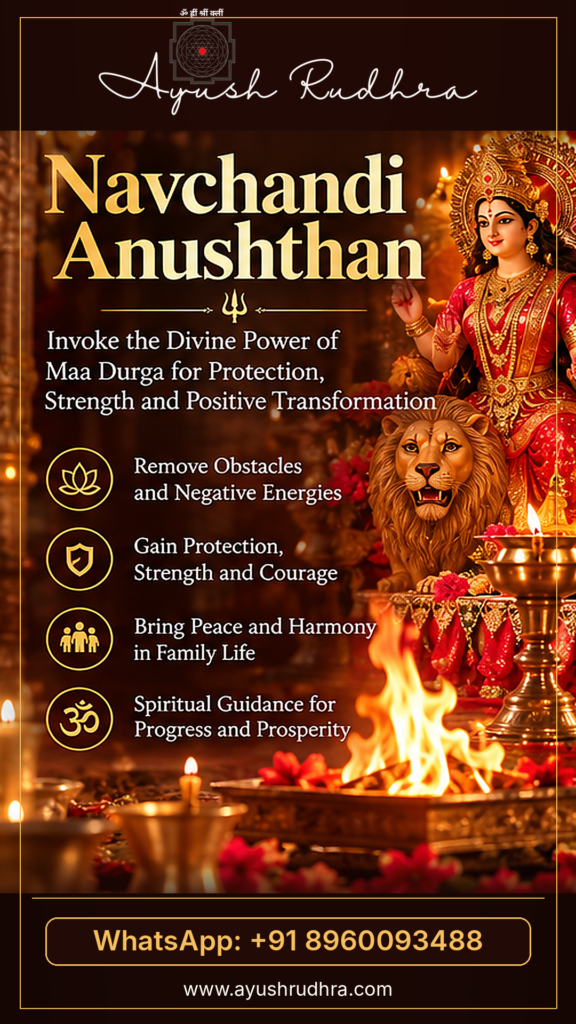
Maa Durga is revered in Hindu traditions as a divine embodiment of strength, compassion and protection. Her iconography—including weapons, the lion and the blessing gesture—expresses different aspects of divine power and courage. During festivals and family observances, devotees may offer flowers, light a diya, recite hymns or participate in communal worship as expressions of reverence.
People may approach Navchandi at a moment of personal uncertainty. A new responsibility, family disagreement, an upcoming ceremony or a long period of stress can encourage someone to seek a grounded devotional routine. Others simply wish to offer thanks without facing a particular problem. Both are valid motivations within religious life.
It is important not to tell a worried family that normal setbacks are proof of a curse or hidden supernatural attack. Financial difficulty, illness, family tension and career delays have real-world causes that deserve proper attention. Spiritual care can sit alongside constructive actions without being used to frighten people or delay needed help.
What Is Sankalp in Navchandi Puja?
Sankalp broadly refers to a deliberate intention or resolution stated before or as part of a religious observance. In a formal setting, the person leading the puja may include customary references to the participants, time, place and purpose. The details of the statement depend on tradition and should be guided by the ritual leader.
For the devotee, the important question is why they wish to undertake the observance. An intention focused on courage, peace, gratitude or the wellbeing of loved ones is different from a demand to harm someone or force another person’s decisions. A thoughtful sankalp can help a family articulate a shared hope while remaining respectful of others.
You do not need to arrive with a dramatic explanation of every hardship. A simple statement such as “We wish to pray for harmony and strength as our family faces a difficult period” is understandable. If guidance is needed, explain the concern honestly and ask how the tradition treats it rather than accepting exaggerated promises.
Typical Elements of a Devotional Observance
Although practices differ, a Navchandi-related arrangement may involve preparatory worship, recitation of Durga Saptashati, offerings, prayers and in some traditions a concluding havan or homa. The arrangement can also involve priests or other ritual participants, a designated location and family participation. None of these elements should be advertised as universally mandatory without clarifying the particular custom being followed.
Preparation and purification: Devotees may prepare a clean worship space and gather customary items such as flowers, water, a diya or other offerings. The exact materials should be confirmed with the person conducting the ritual, especially if an event is being held at home or at a temple.
Sankalp and invocation: The purpose of the observance is expressed, followed by introductory prayers according to the selected practice. Different families and lineages may organise these steps differently.
Recitation: Durga Saptashati or associated hymns are recited with attention to tradition, pronunciation and the pace suitable for participants. A family should understand the proposed scope instead of assuming every event described online contains the same set of recitations.
Offerings and conclusion: Some observances include a havan, concluding prayers or charitable acts. Ask in advance about any open flame, venue requirements, additional participants and the responsible handling of materials. Fire safety and local rules must be respected.
Is Navchandi Performed Only During Navratri?
Navratri is a major period of Maa Durga worship, and many devotees connect their recitations and observances with these festival days. However, religious families also seek guidance outside Navratri for anniversaries, family occasions or personal devotional commitments. Whether a specific date is appropriate depends on the custom being followed and the people conducting the worship.
No website can establish the single correct date for every household simply from a generic calendar. When timing matters, explain your location, family tradition and practical availability to the ritual organiser. If a date or muhurta is suggested, ask for the basis and whether the arrangement is flexible.
Devotion should not become a source of panic if you cannot organise a large ceremony on a popular date. Many families maintain meaningful prayer routines throughout the year. A responsible adviser can discuss modest alternatives when a full observance is unsuitable.
Navchandi Anushthan for Family Peace and Difficult Times
When family members disagree, gathering for prayer may offer a shared moment of reflection. Some households find comfort in collective worship, singing and the discipline of preparing for a religious occasion. Yet prayer alone does not resolve the practical causes of conflict. Honest conversation, boundaries and, where appropriate, counselling or mediation may be necessary.
If illness is involved, keep medical appointments and follow qualified professional advice. If a business is struggling, review finances and seek appropriate business guidance. If there is a legal dispute, obtain legal support. Anushthan may remain part of a family’s spiritual life without being portrayed as a cure for disease, a guaranteed court outcome or a substitute for financial planning.
Readers should also be cautious of claims that household disagreements prove a hidden curse. It is better to ask a consultant to explain the devotional tradition calmly than to accept a frightening diagnosis followed by escalating fees.
How to Prepare for a Navchandi Consultation
Before contacting a spiritual adviser, decide whether you want to learn about the observance, arrange a ritual, discuss the family’s sankalp or understand which form of worship is suitable. Write down the main question. That helps prevent an unfocused discussion and avoids sharing sensitive information unnecessarily.
You may be asked for your name, city, preferred contact method and purpose of the enquiry. Share only what is relevant. For family matters, protect the privacy of relatives who have not consented to disclosure. Do not send identity documents, financial details, private photographs or payment information to an unverified messenger account.
Ask who will lead the observance, where it would take place, which customary components are included, how long it is expected to last and whether family participation is required. Request clarity about fees, optional materials, timing, cancellation or rescheduling terms. A genuine consultation should allow you to consider the information without immediate pressure.
Guidance for People Outside Mayong or Assam
People across India may learn about Navchandi through online resources or enquire about guidance while living away from their family’s traditional place of worship. Remote communication can help clarify questions, but a remote consultation is not the same as the adviser conducting a ceremony in your own city. Any proposed location and arrangement should be described accurately.
The Ayush Rudhra website identifies Mayong, Assam in its spiritual guidance context and provides an official booking route. If you live elsewhere, ask whether the service is an online conversation, an event arranged at a specified location or advice to help you organise an observance locally. Do not assume there is a physical office in your city based on a city-related search result.
For readers living abroad, time zones, communication methods and any local ceremonial requirements should be discussed before making plans. A transparent process reduces confusion for families coordinating across different countries.
Questions to Ask Before Agreeing to a Puja or Havan
A clear plan is better than an elaborate promise. Ask for an explanation of the practice being recommended and whether it matches your intention. Find out what is included and what would involve an additional charge. Discuss who is responsible for the venue, safety arrangements and required materials.
It is also reasonable to ask whether a simpler prayer, personal recitation or a conversation would be more appropriate. No one should make you feel that financial hardship disqualifies you from devotion. If you cannot proceed with a larger event, taking time to reflect or pursuing a simpler personal practice is a legitimate choice.
Be especially careful of anyone promising that payment will guarantee a marriage, recovery from illness, legal success or control over another person. Such statements are not a reliable basis for a religious or financial decision. Seek practical professional help whenever your circumstances call for it.
The Importance of Respectful Spiritual Advice
People seeking spiritual guidance are sometimes vulnerable because they are worried about loved ones, illness, work or a family crisis. An adviser should communicate with care and avoid turning uncertainty into fear. Privacy, clear costs, realistic expectations and voluntary participation are important parts of a responsible service.
Devotional language can speak of divine blessings, protection or victory over obstacles without claiming that a ritual can be experimentally guaranteed to change external events. Distinguishing faith from proof makes room for sincere belief and informed decision-making at the same time.
Families can also benefit from discussing the purpose of an observance together. When everyone understands the intention, preparation becomes less stressful and participation more meaningful. That sense of unity may be valuable regardless of how events unfold afterward.
Booking Navchandi Guidance Through the Official Website
If you would like to discuss Navchandi Anushthan, Chandi Path or a related devotional question, use the Ayush Rudhra official appointment page. You can also read more on the Navchandi Anushthans service page.
Before booking, review current appointment options and confirm what is included. If you use WhatsApp or a phone number shown on the website, make sure it is the official contact. Do not make payments to unknown intermediaries who claim to represent the service. A consultation can help explain options and traditions, but no guaranteed spiritual result should be implied.
Frequently Asked Questions About Navchandi Anushthan
What is the main purpose of Navchandi Anushthan?
It is a devotional observance connected with Maa Durga worship and Durga Saptashati recitation. Devotees may undertake it as an expression of faith, gratitude, courage or prayer for family wellbeing. Particular practices vary by tradition.
Is Navchandi the same as Chandi Path?
They are related but not always used identically. Chandi Path commonly refers to recitation of Durga Saptashati, while Navchandi may describe a broader organised observance involving recitation and other ritual elements. Ask the organiser which custom is being followed.
What is Durga Saptashati?
Durga Saptashati, also known as Devi Mahatmya, is a sacred text of 700 verses in 13 chapters associated with the Markandeya Purana. It celebrates Maa Durga through narratives of divine strength and the restoration of order.
Can Navchandi be performed outside Navratri?
Families may seek guidance at other times, depending on tradition, purpose and availability. Confirm appropriate arrangements with the person leading the observance rather than relying on an automatic date recommendation.
Is havan always included?
Not necessarily. A havan may be part of some arrangements, but ritual components differ. Request a clear outline before assuming it is included in a proposed service.
What information is needed for a consultation?
Usually a concise explanation of the purpose, contact information and any relevant family or scheduling context is sufficient to start. Avoid sharing unnecessary private records through unverified channels.
Can an anushthan guarantee health, legal or business outcomes?
No. Devotional practices belong to the sphere of faith and personal meaning. They cannot responsibly be promised to cure an illness, win a legal case or produce a business result. Continue appropriate professional action.
How do I contact the official guidance team?
Start with the official appointment and consultation page and verify current contact details there. Avoid informal payment requests and unofficial accounts.
Devotion, Clarity and a Meaningful Next Step
Navchandi Anushthan brings together a respected tradition of Maa Durga worship, the sacred recitation of Durga Saptashati and the thoughtful expression of sankalp. The form of the observance can vary, but its significance for devotees rests in sincere participation, preparation and reverence rather than in an advertised guarantee.
If you are exploring this practice for the first time, begin by understanding the text and the custom you wish to follow. If you are arranging it for family members, discuss the purpose and practical responsibilities together. And if you need personalised guidance, use the official booking page to ask informed questions. Your spiritual choices should be made with dignity, clarity and freedom from fear.
Discuss This Concern Personally with Ayush Rudhra Ji
Send your article reference, birth details and concern on the official WhatsApp. The message opens pre-filled so you do not need to type everything from zero.
Use only the official WhatsApp number and official appointment page.

Ayush Rudhra Universe
Access official appointment information, policy pages, websites, media references, and verified digital platforms from one place.
Explore Official Platforms