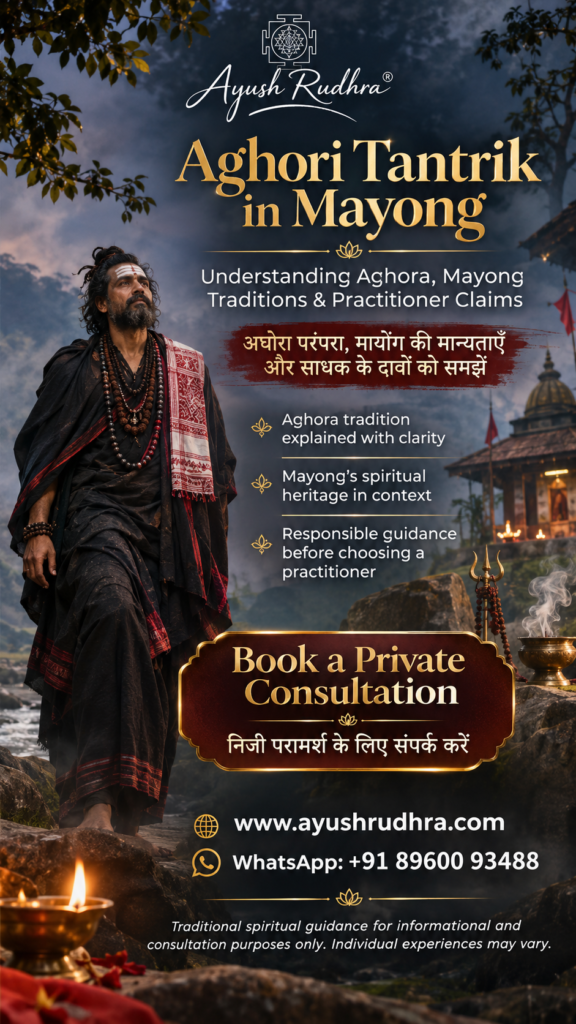
The phrase aghori tantrik in Mayong brings together two powerful images from India’s spiritual vocabulary: the Aghora tradition, often associated in public writing with certain Shaiva ascetic practices, and Mayong, a village in Assam known for its ritual folklore. These subjects have points of cultural contact through broader discussions of Tantra, but they are not interchangeable. A person connected with Mayong is not automatically an Aghori, and an Aghori practitioner is not defined by being from Mayong. This distinction is essential for an informative page that respects actual traditions instead of combining dramatic keywords into a misleading biography.
Some searchers want a practitioner who identifies with Aghora. Others want to understand whether Mayong’s old stories involve Aghori practice. A third group may simply have encountered the term in a social-media video and be looking for safe spiritual consultation. A good article answers those different questions openly, explains what can be documented and avoids invented claims about lineages, supernatural power or secret rituals. Nothing in a search phrase alone establishes an individual’s religious initiation or qualifications.
What Aghora means in broad religious discussion
Aghora is a term found in Shaiva spiritual vocabulary and is associated in some traditions with ideas of fearlessness, non-duality and moving beyond ordinary distinctions of pure and impure. Public attention often focuses on dramatic imagery, especially accounts of ascetics linked to cremation-ground settings. This emphasis can overshadow philosophical and devotional questions about impermanence, the body, death and attachment. Not every discussion of Aghora concerns extreme conduct, and not every person using the word follows the same understanding.
Scholarly work on the Aghori presence around Varanasi’s cremation grounds, for example, explores how ideas about mortality and non-duality are represented in practice and understood by observers. That is a different kind of material from an advertisement promising instant results. Readers seeking a basic cultural framework can consult the academic research summary on Aghori practices in Varanasi before interpreting a sensational claim about a practitioner.
Where Mayong fits into this subject
Mayong lies in Morigaon district in Assam, near Pobitora Wildlife Sanctuary. Assam Tourism describes its reputation for traditional magic and ritual folklore. Researchers have discussed Mayong’s local practitioners, including terms such as bej or ojha, in relation to indigenous healing and ritual narratives. The forms of practice described in this local context should not automatically be relabelled Aghori just because both appear under the broad and commercially attractive word Tantra.
The village’s material heritage is important in its own right. Community preservation efforts, ritual objects and manuscripts help explain how stories and forms of knowledge have been recorded. A traveller or researcher can learn about this history without assuming every popular legend happened literally. The Mayong museum guide discusses that evidentiary side of the story, and Assam Tourism gives the local geographic context.
Aghori, Tantrik, Sadhu and Bej are not synonyms
Aghori generally refers to an association with a particular Shaiva ascetic orientation or tradition. Tantrik is a much broader everyday label for a practitioner linked with Tantra. Sadhu is a wider term for religious renunciants or holy persons in various Hindu contexts. Bej and ojha can refer to practitioners in particular local Assamese cultural settings. The meanings of these terms vary across communities and historical periods, so they should not be treated as certification categories that can be swapped on a website for SEO purposes.
For a prospective client, this matters in a practical way. A person seeking horoscope interpretation needs to ask about astrology. A person seeking a conversation about Aghora philosophy needs an adviser familiar with that subject. A person interested in a local healing tradition is asking a different question again. An advertisement that promises every service under every label may be easier to find online, but it gives the reader less information about what will actually happen during a consultation.
Why online images are poor evidence of spiritual identity
Ash, rudraksha, saffron clothing, skull imagery, a temple photograph or an intense portrait are commonly used as symbols in religious and promotional visual culture. None proves that the person depicted was initiated into a specific tradition. An image may be staged, edited, taken at a tourist site or attached to a profile without consent. Likewise, a video titled “most powerful Aghori” does not establish a lineage or offer evidence for a claim about a ritual’s outcome.
If an individual’s association with Aghora matters to you, read their own description carefully. Ask whether they identify as an Aghori, are discussing Aghora academically, or are offering a related but distinct spiritual interpretation. Ask what may be publicly verified and what is a personal matter of faith. The honest answer may be that no specific Aghori identity has been established. That should be stated clearly rather than hidden behind an exciting headline.
The relationship between Tantra, Shakta and Shaiva traditions
Tantra is not one single school. Various streams of Hindu religious practice, including Shaiva and Shakta contexts, have developed distinct texts, ritual ideas and forms of devotion. Aghora-related discussions commonly arise within Shaiva frameworks, while Mayong’s wider regional narratives may refer to local practice, worship and different Tantric influences. The connections are historically complex. There is no scholarly basis for declaring every Tantrik in Assam an Aghori or every Aghori a practitioner of Mayong folklore.
In consumer-facing content, readers are better served by accurate explanations of these distinctions than by a claim that one adviser simultaneously possesses every type of spiritual knowledge. The Tantrik in Mayong service page is appropriate for understanding the site’s broad Tantrik consultation category. Questions specifically about the person’s stated background belong on the official biography.
What can actually be verified about a claimed practitioner
A biography can record names of teachers, places visited, periods of study and traditions the person says they follow. Public photographs, interviews or media coverage may verify that certain events or statements were reported. They do not automatically establish a spiritual status or the efficacy of a ritual. There is no single public registry that certifies all traditions represented by the broad term Tantrik. A responsible reader therefore asks questions that can receive transparent answers instead of seeking a fictional universal credential.
If a website claims a person has a specific initiation, distinguish the site’s account from independent documentation. Do not add an Aghori title to a practitioner simply because it is a popular keyword. Ayush Rudhra’s biography discusses his stated spiritual journey and Rudri Tantra background. The supplied public materials should not be stretched into an unverified declaration that he is formally an Aghori ascetic. That editorial boundary protects the reader and the practitioner alike.
Can Aghora teachings be discussed without performing a ritual?
Yes. A person may seek a conceptual discussion of impermanence, fear, devotion or philosophical approaches to the self. This is quite different from requesting participation in a religious observance. An introductory consultation can clarify which discussion is appropriate and whether the practitioner actually offers that subject. There should be no presumption that a client must undertake an intense or secret practice to ask an educational question.
Descriptions of cremation-ground rites or extreme asceticism may be culturally relevant in scholarship, but they are not instructions for ordinary consumers to imitate. A reputable adviser should not encourage unsafe, unlawful or exploitative conduct. Spiritual study can be approached through books, public talks, respectful conversation and verified cultural resources. A person’s curiosity about Aghora does not imply consent to any physical act or ceremonial undertaking.
How Aghori advertising can exploit fears and fantasies
The term Aghori is sometimes attached to promises of supernatural protection, enemy destruction, lost-love control or wealth acquisition. These claims attract attention precisely because they sound extraordinary. A vulnerable client may be told that only a dangerous ritual can prevent disaster, and that disclosure to family would make it fail. Those are warning signs. No one should be pressured to pay because a practitioner claims special access to invisible threats or secret powers.
If you are afraid of a curse or harassment, separate the immediate practical concern from any interest in traditional philosophy. The relevant service may be a calm discussion of fear, an ordinary safety assessment or professional support—not an Aghora ritual. For the narrower belief-related subject, the Mayong black magic guide is a more appropriate starting point. This article’s role is to explain the meaning and difference of traditions.
Where Ayush Rudhra’s site fits the Aghori search
The Ayush Rudhra website offers an official practitioner profile, Tantra-related service information and private consultation arrangements. Readers can explore the About page to understand the background that is actually described, then ask the team whether their specific question concerns Aghora philosophy, local Mayong tradition, Vedic astrology or general spiritual guidance. The service should be selected according to what is genuinely offered, not according to the most dramatic label in a search result.
The site also describes traditional Tantric Anushthan, a category distinct from introductory cultural explanation. No one should infer that an Aghori service, specific initiation or in-person Mayong ceremony is automatically available. Confirm any consultation format and what it includes on the official booking page. The published WhatsApp enquiry contact is +91 89600 93488.
How to research the subject respectfully
Start with a precise question. “What is Aghora philosophy?” is clearer than “Who has the strongest secret power?” “How are Mayong’s bej traditions described in historical sources?” points toward local scholarship. “Does this specific practitioner personally identify with Aghori practice?” requires a direct answer from that person. Questions about a proposed ritual require an explanation of scope, costs, voluntary consent and safety. Keeping these aims distinct makes research less vulnerable to sensationalism.
Consult sources that identify their authors and methods. Government tourism pages provide geographic and heritage context. Academic studies may offer documented interviews or interpretations, with limits. A practitioner’s site provides their own account and booking policies. None of these sources should be presented as a universal proof of supernatural activity. When sources disagree, say what each source is actually describing rather than inventing certainty.
Frequently asked questions about Aghori Tantriks in Mayong
Is an Aghori Tantrik the same as a Mayong Tantrik?
No. Aghori is associated with specific religious ideas and ascetic traditions, while Mayong refers to a place with its own ritual and folk-healing heritage. The labels may appear in the same discussion without meaning the same thing.
Are all Tantriks in Mayong Aghoris?
No such blanket conclusion is supported. Practitioners may have different backgrounds, and a connection with Mayong does not by itself establish Aghori identity.
Does Mayong have documented ritual folklore?
Yes. Assam Tourism and scholarly writing document Mayong’s association with ritual traditions and local cultural history. That documentation is different from proof of extraordinary supernatural claims.
Is Ayush Rudhra Ji officially documented as an Aghori ascetic?
The public biography reviewed for this content describes a Rudri Tantra and spiritual journey narrative. That should not be converted into a formal Aghori identification without specific supporting evidence.
Should I attempt practices shown in dramatic Aghori videos?
No. Online videos may be sensationalised and can omit health, safety, legal and religious context. Do not imitate dangerous acts or participate in anything without informed consent and appropriate safeguards.
Where can I ask about the type of consultation actually offered?
Use the official Ayush Rudhra appointment page or WhatsApp +91 89600 93488. State the exact subject so the team can explain whether suitable guidance is available.
Accuracy note: This article is about the meaning of the search phrase and the traditions it combines. It does not assert an unverified Aghori identity, initiate anyone into a practice or promise supernatural outcomes.
Discuss This Concern Personally with Ayush Rudhra Ji
Send your article reference, birth details and concern on the official WhatsApp. The message opens pre-filled so you do not need to type everything from zero.
Use only the official WhatsApp number and official appointment page.
Ayush Rudhra Universe
Access official appointment information, policy pages, websites, media references, and verified digital platforms from one place.
Explore Official Platforms