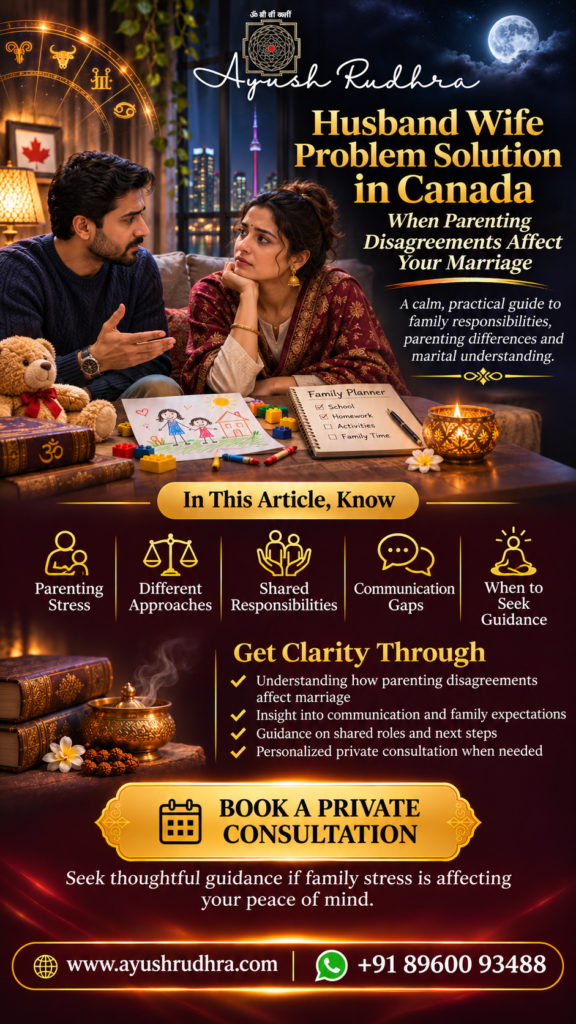
When a disagreement about your child’s bedtime, education or behaviour turns into another argument about your marriage, it can feel as though you and your spouse have stopped being a team. You may agree that you both love your children, yet disagree about almost every decision concerning them. If you are seeking a husband wife problem solution in Canada for this reason, begin by separating the parenting decision from the unresolved feelings between you as partners.
Ayush Rudhra Ji offers private astrology and traditional spiritual guidance for marital and family concerns. For couples living in Canada, a consultation can provide an opportunity to discuss their circumstances and consider traditional interpretations of family life and emotional expectations. It is not a substitute for professional parenting advice, nor can a birth chart establish which parent is right. The aim is to understand the disagreement and identify a constructive next step.
Why a disagreement about children can become a marriage problem
Two parents can want exactly the same outcome for their child and still disagree on how to achieve it. One believes that a clear routine teaches responsibility. The other wants to leave enough room for independence. Neither approach automatically means a parent cares less. The trouble begins when a difference of opinion is understood as a personal criticism.
Imagine a couple in Brampton whose child has been spending more time playing video games. One parent introduces a weekend screen-time rule without discussing it. The other removes the restriction after the child complains. The first feels undermined; the second feels excluded from the decision. By evening, the couple is no longer discussing a screen. They are arguing about respect, authority and whether their opinion matters in the home.
This is a fictional example, but the distinction is useful. A parenting problem may require a change in a child’s routine, whereas a marriage problem may require an agreement about who makes decisions and how partners support each other. Addressing only the routine leaves the deeper frustration untouched. Addressing only the marriage without making a practical parenting decision can leave everyone confused.
Raising children between Canadian and Indian family traditions
Some Indian-origin families in Canada are negotiating expectations they did not have to discuss before becoming parents. A couple in Surrey may want their children to speak a heritage language at home while also feeling comfortable in their local school community. One parent may value regular religious observances; another may prefer to let the children make those choices as they grow older. Relatives in India may have their own views on education, discipline and children’s independence.
These questions are not unique to Indian families or to Canada. But the distance from extended family can affect how a couple approaches them. Advice that once came during a visit to a grandparent’s home might now arrive through frequent video calls. A spouse may feel that a relative is being consulted about matters that belong within the marriage. The other spouse may experience the same calls as welcome support during a demanding period.
Rather than deciding whether one culture or generation has the better parenting method, discuss which traditions matter to you personally. A family can maintain a language, celebrate a festival or make space for prayer without agreeing on every belief. Ask which activities both partners would enjoy sharing with the children and which should remain optional. The answer should suit the household you actually have, not an ideal household imagined by somebody else.
Five questions that reveal what the conflict is really about
Before seeking a marriage problem solution in Canada, try to identify the particular decision that repeatedly creates tension. Write the answers separately if speaking about them usually leads to arguments. The purpose is to make the issue more concrete, not to collect evidence against your spouse.
- What decision is being disputed? Describe one recent disagreement rather than summarising your partner’s entire personality.
- What value is each parent protecting? Safety, independence, education, religious continuity or a child’s comfort may be the real concern.
- Who is carrying out the decision? A rule may be easy to suggest but difficult for the parent managing school mornings or bedtime every day.
- What did the children observe? Consider whether they witnessed an argument or received conflicting instructions, without asking them to decide which parent is correct.
- What can be agreed for the next week? A short, manageable arrangement gives both parents something specific to evaluate together.
For example, the parent who wants more homework time might discover that the other is not against education but worried about exhaustion after school. A workable decision could include a rest period followed by a defined study session. The original problem changes once both concerns are understood. It becomes possible to disagree without treating the disagreement as disloyalty.
When unequal parenting responsibilities create resentment
Sometimes the most painful argument is not actually about how to raise the child. It is about who has been doing the work. Consider a household in Calgary where one spouse usually handles daycare collection, appointment reminders, school emails and planning meals. The other may contribute financially and help on weekends but not realise how much coordination happens during the week.
When the second parent suggests a new family rule, the first may hear another demand rather than a helpful idea. Both partners might sincerely believe they are making important contributions, yet their experiences of the household differ. A discussion of love and marriage problems becomes more useful when it includes this invisible planning work.
Make a brief inventory of recurring tasks: transport, school communication, shopping, medical appointments, household routines and activities. Include who remembers and organises the task, not only who carries it out. Agree on an owner for a responsibility from beginning to end, rather than requiring one person to keep reminding the other. Account for actual work hours and the support each spouse can access locally.
A fair arrangement does not necessarily divide every task in half. It should be understood and accepted by both partners, with room to change as schedules or children’s needs change. A spouse who feels heard in this discussion may be better able to explain the emotional concerns that have been building behind the practical disagreements.
How traditional Vedic astrology approaches family and marriage
For families who value Jyotisha, a private astrology discussion can consider the traditional symbolism associated with home, children and marriage. The fourth house is commonly connected with domestic life, the fifth with children among other matters, and the seventh with partnership. Practitioners also consider planetary rulers, aspects and the wider chart rather than isolating a single placement.
The Moon is traditionally associated with emotional experience and Mercury with communication. A practitioner might use these themes to discuss how a client describes a difficult conversation or responds to changes at home. Dasha, or planetary period, may be another interpretative element when the client asks about a particular phase of family life.
These are cultural and spiritual interpretations, not scientifically established explanations for a child’s behaviour or a spouse’s actions. A difficult placement cannot prove that a husband is irresponsible, a wife is overly protective or a child will face harm. Nor should a child’s horoscope be used to decide which parent deserves authority.
In a consultation, useful questions include: What does this traditional interpretation mean in relation to the concern I have described? What assumption should I reconsider? Is there a voluntary spiritual practice I can follow without placing pressure on my spouse or children? The broader marital problem consultation service explains the related scope of relationship guidance.
Protect your marriage from becoming only a parenting partnership
Many couples notice that their conversations have narrowed to shopping lists, school schedules and household expenses. They may be functioning as capable parents while having very little time to speak as a couple. A conflict about the children then carries the additional weight of feeling forgotten by the person they married.
Consider making a distinction between a household meeting and time spent together. Use a short scheduled conversation for decisions about activities, expenses and family logistics. Outside that conversation, create a modest opportunity to reconnect that does not require spending a large amount of money or arranging a special evening. A shared cup of tea after the children sleep or a walk during a free period can be realistic starting points.
Ask about something your spouse experienced that day without immediately turning the answer into a request. Notice an effort that would otherwise pass without acknowledgement. If affection feels awkward after prolonged conflict, do not demand an immediate return to the way things were before. A small, mutually welcome gesture is more useful than a grand gesture that ignores unresolved concerns.
If you are seeking relationship problem solution guidance in Canada because emotional distance has become the central issue, the love and relationship guidance page may also help you choose the relevant consultation topic.
A practical approach for the next school week
Choose an ordinary week rather than a holiday or a period when one parent is away. On the first day, agree on the single decision that needs attention most urgently. It could be a morning routine, bedtime, a child’s extracurricular activity or a disagreement about contacting grandparents. Write the agreement in one sentence that both parents understand.
During the week, avoid changing the rule in response to a disagreement between adults. If something unexpected happens, discuss the adjustment away from the children when possible. Do not make a child carry messages between parents or ask them to keep a disagreement secret. At the end of the week, review what actually worked: the child’s response, how manageable the routine was and how each parent felt carrying it out.
Next, choose one moment to discuss the marriage itself. You might say that you miss being able to make decisions together without worrying about criticism. Ask what would make the next conversation easier for both of you. This is different from reviewing the child’s routine; it is an invitation to rebuild cooperation.
When arguments become threatening, or one partner is afraid to disagree, a joint discussion may not be safe. In those circumstances, prioritise confidential specialist assistance. The Government of Canada’s family violence support directory provides links to local resources. In immediate danger in Canada, call 911.
If separation is already being discussed
Some visitors searching for husband-wife dispute guidance are already considering living apart. Parenting disagreements then become especially sensitive, because the adults may also be deciding where the children will live and how responsibilities will be shared. An astrology consultation cannot determine parenting arrangements, establish legal rights or replace a family lawyer.
Justice Canada’s guidance on parenting after separation explains why protecting children from ongoing conflict and establishing an appropriate parenting relationship are important. If separation is a possibility, obtain advice suitable for your province or territory. A counsellor, family mediator where safe, or qualified legal professional may be relevant depending on the issue.
You may still wish to discuss your beliefs, personal priorities or emotional uncertainty with a spiritual adviser. Keep that conversation separate from legal decisions about your children. It should help you consider your choices, not persuade you to remain in an unsafe relationship or promise that a ritual will prevent divorce.
Private marriage consultation for clients in Canada
Ayush Rudhra Ji’s Canada consultation page provides information for clients seeking remote guidance. Whether you are living in Ontario, British Columbia, Alberta or another province, specify your city and time zone when contacting the official team. These are online consultation service areas; an office in your city is not implied.
Before requesting a session, prepare the approximate date when disagreements became frequent, a brief description of one example, the changes you have tried and the main question you wish to discuss. If you want birth-chart interpretation, mention whether your own birth time is known. Share another adult’s birth information only with their permission. There is no need to send your children’s school records, photographs or sensitive documents to explain an ordinary parenting disagreement.
Visit the official appointment page for current options and fees, or contact the team through WhatsApp (+91 89600 93488) to clarify the process. A private consultation is an opportunity to examine your concern; any subsequent traditional practice should be explained and chosen voluntarily.
Frequently asked questions
Can I request a husband wife problem solution in Canada if my spouse will not attend?
Yes. An individual session can focus on your own concerns and decisions. It cannot establish your spouse’s private intentions or create a parenting agreement on their behalf.
Can astrology tell which of us has the better parenting approach?
No. Parenting decisions should consider the child’s age, needs and wellbeing, as well as appropriate professional advice. Traditional chart interpretation is a separate form of reflection.
How can I manage grandparents’ advice without disrespecting them?
Discuss a shared approach with your spouse first. Thank relatives for their concern while explaining that everyday parenting decisions must be made by the people responsible for the child’s care.
What if we disagree about our child’s religious upbringing?
Identify which traditions each of you considers important and discuss what participation would look like in daily life. Avoid placing the child in the middle of a disagreement about loyalty to either parent.
Is a traditional remedy necessary whenever marriage conflict repeats?
No. A repeating problem may reflect an unresolved routine, an unfair workload or an issue that requires professional support. Spiritual practices are optional and no particular ritual is assumed before a consultation.
Can we arrange a remote appointment from Toronto or Vancouver?
Canadian clients can request an online appointment through the official team. Include your city, local time zone and preferred window, and confirm availability before making payment.
Make room for both the marriage and the family
Being good parents does not mean agreeing on every decision. It does require a way to discuss differences without making the children responsible for the outcome. If you want to consider your circumstances through traditional astrology, request a private discussion with Ayush Rudhra Ji and bring one specific marital question. Keep your children’s wellbeing, your own safety and mutual respect at the centre of every decision.
Astrological and spiritual guidance is interpretative and does not guarantee reconciliation or family harmony. For child development, mental health, safety or legal matters, obtain qualified professional support.
Discuss This Concern Personally with Ayush Rudhra Ji
Send your article reference, birth details and concern on the official WhatsApp. The message opens pre-filled so you do not need to type everything from zero.
Use only the official WhatsApp number and official appointment page.

Ayush Rudhra Universe
Access official appointment information, policy pages, websites, media references, and verified digital platforms from one place.
Explore Official Platforms