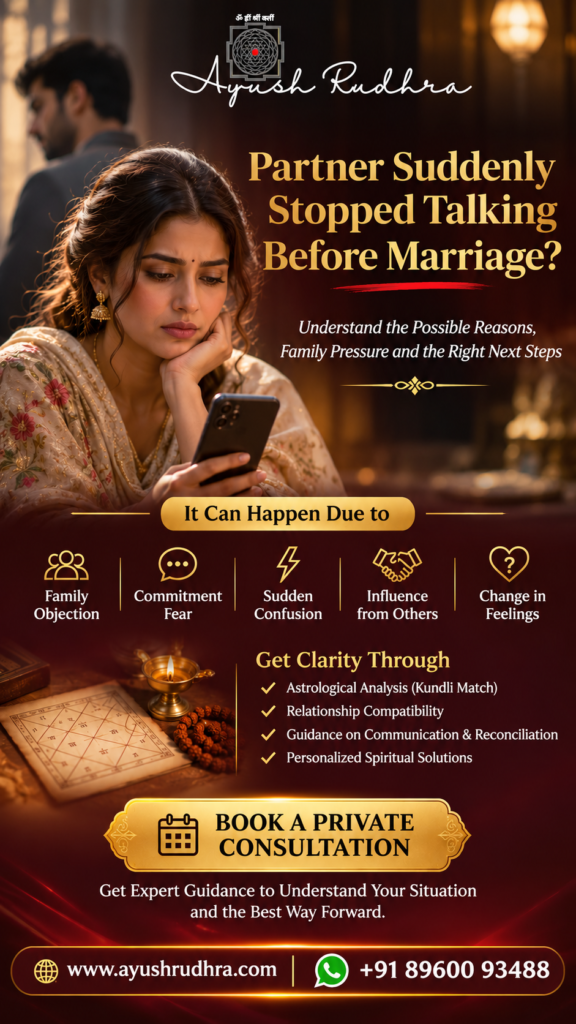
You spoke every day. You discussed the future, perhaps even exchanged promises about marriage. Then, just when the relationship began moving toward a formal commitment, the messages became shorter. Calls went unanswered. Conversations about family meetings or a wedding date were repeatedly postponed. Now you are wondering: Why has my partner suddenly stopped talking before marriage?
The uncertainty can be more exhausting than an argument. An argument at least gives you something specific to address. Silence leaves space for dozens of explanations, from family objections to personal doubts, work pressure or a change of heart. The temptation is to search for one immediate answer. Yet no outsider, astrologer or online article can know another person’s intentions merely from their lack of response.
What you can do is understand the situation, communicate respectfully, protect your dignity and decide when additional guidance might help. This article is about those next steps—not forcing a commitment or promising that a particular person will return.
Why communication sometimes changes when marriage becomes serious
Marriage is more than an expression of affection. It may involve shared finances, family expectations, living arrangements, careers, religion, cultural traditions and long-term responsibility. Two people can care about each other and still discover that they have different expectations about these questions.
A couple might enjoy a relationship while marriage remains a distant possibility. When parents ask for a date, a family introduces an alternative match or a job relocation becomes real, decisions suddenly carry consequences. One partner may begin withdrawing rather than explain their concerns. That is not necessarily fair to the other person, but understanding the pressure is more useful than assuming a single cause.
In other cases, silence is a genuine indication that the other person no longer wants to continue. The important distinction is between a temporary interruption, an unresolved disagreement and a repeated pattern of avoiding meaningful conversation.
Seven possible reasons your partner is not responding
1. Family opposition has become stronger
A partner may initially believe that their family will accept a love marriage, only to encounter objections about community, caste, religion, financial security or personal history. Some people try to negotiate privately and stop communicating while doing so. Others become unwilling to challenge their family. Neither situation can be diagnosed from silence alone. Look for concrete information: Did objections begin after a family discussion? Has your partner explained what is being considered? Is there any agreed time to revisit the conversation?
2. Fear of commitment or practical responsibility
The emotional idea of marriage may feel reassuring, while the practical decision creates anxiety. A partner may worry about career stability, housing, debt or whether the relationship is genuinely ready for lifelong responsibility. Commitment anxiety is not proof that love has disappeared. Equally, anxiety should not become a permanent excuse for keeping someone uncertain. A constructive conversation needs both an honest explanation and an achievable next step.
3. An unresolved argument or loss of trust
Sometimes the final message before the silence contains the clue. A disagreement about family boundaries, privacy, future plans or past behaviour may have been left unresolved. If the relationship previously had recurring criticism, jealousy or conflict, a partner may be avoiding another confrontation. It is worth reflecting on what happened without automatically accepting all the blame. Both people remain responsible for respectful communication.
4. Different marriage timelines
One person may want engagement within months; the other may not be ready for several years. These differences can exist even in affectionate relationships. Repeatedly postponing a date without discussing an alternative is not the same as jointly agreeing to wait. Ask whether the two of you have actually shared a timeline or merely assumed that you want the same thing.
5. Emotional overload or a personal difficulty
A difficult family event, illness, job loss or intense stress may temporarily change someone’s communication habits. Give genuine circumstances appropriate space. But distinguish a known, communicated difficulty from unexplained disappearance. A short message such as “I am dealing with something difficult and will contact you on Friday” is very different from weeks of complete avoidance.
6. Outside influence or misinformation
Relatives and friends can sometimes introduce doubts or repeat unverified allegations. Before concluding that a third person is deliberately interfering, try to identify facts. Has anyone made a specific claim? Was it discussed directly with the partner? Accusations about betrayal or malicious spiritual influence, without reliable evidence, can damage trust further. Do not confront strangers or share private information simply because you suspect interference.
7. A change of decision that has not been expressed
One of the hardest possibilities is that your partner has reconsidered the relationship but does not know how to say so. This possibility should not be ignored just because it is painful. Marriage requires freely given and continuing agreement from both people. A promise made months ago does not override a person’s present decision, and no spiritual consultation can replace that consent.
Is it temporary silence, ghosting or a pattern of avoidance?
A delayed reply does not automatically mean the relationship has ended. People work, travel, care for relatives and have different communication habits. Look instead at the broader pattern. Is the silence unusual for this person? Have they stopped responding to important questions over an extended period? Do they repeatedly promise to call and then disappear? Do they give brief signs of affection but refuse any meaningful conversation about the future?
These distinctions matter because a brief pause and a sustained refusal to communicate call for different responses. Psychologists also use the term ghosting for abruptly ending contact without explanation. The American Psychological Association’s discussion of ghosting emphasizes the painful lack of closure and the importance of respecting the other person’s choice rather than pursuing unlimited contact.
If the person has explicitly asked you not to contact them, respect that boundary. If there has been no such request and the silence is unusual, one calm check-in can be reasonable. Avoid treating social media activity as definitive proof of their thoughts or intentions.
What to do when your fiancé or partner stops talking
Step 1: Separate facts from assumptions
Write down the actual sequence of events: when communication changed, the last significant discussion, whether families have spoken and which promises were clearly made. Then write a separate list of fears. “They have not replied for five days” is a fact. “Their family has persuaded them to marry someone else” may be a fear unless you have evidence. This simple distinction can prevent a difficult situation from becoming an imagined crisis.
Step 2: Send one respectful, direct message
If contact is welcome and it feels safe to do so, consider a message that identifies the concern without issuing threats or demanding an immediate reply. For example: “I have noticed we have not been able to discuss our marriage plans recently. I understand you may need time. I would appreciate a clear conversation about whether we both still want to move forward. Please let me know when you are comfortable speaking.”
Do not send this repeatedly, turn it into an ultimatum or ask friends to deliver it after you have been asked to stop contacting the person. The aim is clarity, not pressure.
Step 3: Give space without putting your life indefinitely on hold
An agreed pause can be healthy; indefinite uncertainty often is not. You can decide privately how long you are willing to wait for a conversation, taking circumstances into account. This is a boundary for your own choices, not a punishment for the other person. During that time, maintain work, sleep, family relationships and ordinary routines rather than checking your phone constantly.
Step 4: Discuss the actual marriage decision
If communication resumes, do not settle only for reassuring phrases like “everything will be fine.” Ask what each person wants now, what obstacles exist and whether both are prepared to take practical steps. Useful topics include family approval, finances, location after marriage, an approximate timeline and the approach to future disagreements. A relationship cannot become secure through promises that never lead to decisions.
Step 5: Involve families carefully, if appropriate
When both partners have already invited family participation, a calm meeting may help clarify practical objections. But do not use parents, relatives or community pressure to make a reluctant person agree. Family discussions should support informed choices, not replace the couple’s willingness. If there is risk of violence, forced marriage, threats or coercion, prioritize safety and qualified local assistance rather than a confrontation.
Step 6: Prepare for an answer you may not want
The reply may be encouraging, uncertain or final. You can feel disappointed without treating a refusal as an injustice that must be reversed. If the relationship is ending, consider what support you need and what commitments—such as deposits, travel bookings or family announcements—must be addressed practically. Closure may come from making a decision yourself, even when the other person offers no explanation.
What not to do when marriage talks suddenly stop
Avoid repeatedly calling from different numbers, tracking a person’s movements, accessing private accounts or recruiting strangers to confront them. Those actions can violate privacy and create legal or safety problems. Do not assume that dreams, social-media posts or another person’s claims reveal a hidden relationship. Avoid paying anyone who promises to control a partner’s thoughts or guarantee a wedding by a fixed date.
It is equally important not to ignore your own welfare. When uncertainty starts interfering with your sleep, work or ability to function, talking with a trusted person or qualified mental-health professional may be more immediately helpful than searching for another prediction. Good guidance should make your decisions clearer, not leave you frightened and dependent.
Can astrology help when a partner changes before marriage?
Some people use Vedic astrology and traditional spiritual consultation as ways to reflect on relationship patterns, compatibility and timing. In a birth-chart-based discussion, an astrologer may look at relationship significators, marriage-related houses and planetary periods. Such interpretations belong to a traditional belief system; they are not scientific evidence of what a particular partner is thinking or whether they will agree to marry.
A responsible consultation combines the client’s account of events with the limitations of the available birth details. It can help organize questions: Are we facing a communication gap, a family issue or an incompatible timeline? What is within my control? What conversation needs to happen before I make a decision? It must not present an alleged planetary influence as proof of infidelity, black magic or someone else’s hidden intentions.
For broader service information, explore relationship and love problem guidance from Ayush Rudhra. If family discussions are central, the separate family and marriage issues guidance page explains that consultation focus. These are service pages; this article is intended to help you understand the specific situation of sudden silence before marriage.
When a private relationship consultation may be worth considering
Consider speaking with a qualified advisor when you have gathered the basic facts but remain uncertain about how to proceed, when family objections involve several people or when the relationship has a repeated pattern of breakup and reconciliation. The most useful consultation begins with a clear question, not the expectation of a guaranteed outcome.
Prepare a brief timeline, your own birth details if you want a traditional chart reading, the known relationship history, the current communication status and the decision you are trying to make. If another person’s details are involved, share them responsibly and only where appropriate. You need not send intimate images, passwords, private chats or financial documents to establish the basic concern.
Guru Ji Ayush Rudhra Ji offers appointment-based, private astrology and spiritual guidance for relationship concerns. The consultation can be used to discuss the circumstances and possible next steps, while recognizing that another person’s decision remains their own. To review current plans and the official process, visit Book a Private Consultation. Fees, availability and appointment details should be checked on the booking page rather than assumed from an article.
Frequently asked questions
Why does my partner ignore me just before marriage?
There is no single explanation. Family objections, commitment fears, unresolved conflict, different timelines, personal stress or a changed decision may all be possible. The only reliable way to clarify a willing partner’s position is respectful direct communication. Do not treat silence alone as proof of a specific cause.
Should I contact my partner’s family if they stop replying?
Only when family participation is already appropriate and doing so would not violate the partner’s boundaries or create risk. It is generally better to seek a direct conversation first. Do not use relatives as a way to pressure someone into marriage.
How long should I wait for a reply about marriage?
There is no universal waiting period. Consider the person’s circumstances, the history of communication and your own need for a decision. A mutually agreed timeframe is more helpful than waiting indefinitely without any clear plan.
Can Shani, Rahu or other planets make a partner stop talking?
In Vedic astrology, planetary placements and periods are interpreted symbolically in relation to themes such as responsibility, uncertainty or communication. They cannot establish why an identifiable person has stopped replying. Real-life behaviour and freely expressed decisions remain the most important evidence.
Can a mantra make someone contact me or agree to marry?
There is no reliable basis for a guarantee that chanting or ritual practice can make another person contact you or consent to marriage. Personal prayer or meditation may support calm reflection, but never replaces mutual willingness or practical communication.
Is a love marriage still possible after family opposition?
It may be, when both adults clearly want the relationship and can address practical barriers safely. But an objection does not automatically mean a couple will reconcile, and family or spiritual advice should never be used to override consent.
What if my partner returns after weeks of silence?
Listen to their explanation and assess whether both of you can build a more reliable pattern of communication. Discuss what would need to change before making new promises. You do not have to accept an arrangement that continues to cause uncertainty.
How do I book a private relationship consultation?
Use the official Ayush Rudhra appointment page to review the available plans and process. Explain the relationship concern factually, including how long communication has been interrupted and what decision you need help considering.
A clear next step is more valuable than another anxious guess
When someone suddenly stops talking before marriage, it is natural to want an immediate explanation. But repeated guessing, pressure or dramatic promises rarely create understanding. Begin with what you know. Communicate once, clearly and respectfully. Leave room for a genuine answer, including one that changes your plans. Protect your dignity and safety throughout.
Need a private, structured discussion about relationship uncertainty? Review the official Relationship Guidance information or Book an Appointment with Guru Ji Ayush Rudhra Ji. Consultations are intended for individual case understanding and reflective spiritual guidance, not guaranteed reconciliation or control over another person.
Discuss This Concern Personally with Ayush Rudhra Ji
Send your article reference, birth details and concern on the official WhatsApp. The message opens pre-filled so you do not need to type everything from zero.
Use only the official WhatsApp number and official appointment page.

Ayush Rudhra Universe
Access official appointment information, policy pages, websites, media references, and verified digital platforms from one place.
Explore Official Platforms